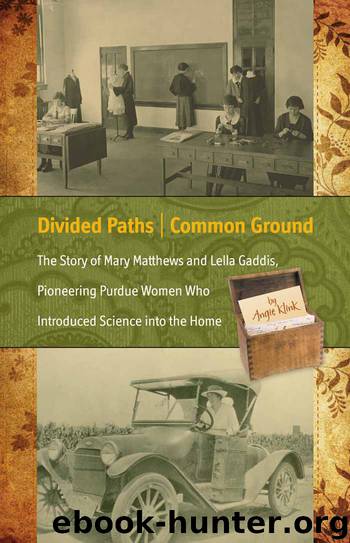
Divided Paths, Common Ground by Angie Klink
Author:Angie Klink
Language: eng
Format: epub
ISBN: 9781557535917
Publisher: Purdue University Press
February 21: Went to the Citizen’s Meeting to learn to vote and found out I am a Republican.
November 2: Came home from school and cast my first vote.
November 3: Such a landslide for the Republicans was never heard of.
Warren G. Harding was elected in the 1920 election, and Kate records her own spin on Harding’s win: “March 4, 1921: A new president. Warren G. Harding. Poor Woodrow Wilson is a wreck.”
In Taking the University to the People: Seventy-Five Years of Cooperative Extension by Wayne D. Rasmussen, he states, “The women who came into extension work early and made it a lifetime career had rural backgrounds, a good basic education, good communication skills and a sense of mission” (p. 87). To perfection, those words describe Lella Gaddis, first state leader of home demonstration. Lella grew up on a farm in Rossville, Indiana; she had a Purdue education; she was not afraid to speak her mind and tell people how things should be done; and most importantly, she exuded an inner fire of purpose to better the lives of rural women. After World War I, many of the emergency home demonstration agents were discharged. In 1920, Lella had only two agents in Indiana—one in Hendricks County and another in Vanderburgh County. With her forces depleted within the counties, she and her agents trained farm women in leadership techniques and equipped them with skills that enabled them to teach others in their Home Economics Clubs. Actually, the shortage of agents helped rural women even more by giving them opportunities in management-like roles and public speaking—positions that were very foreign territory for farm women of the time. In DeKalb County, Lella helped organize the Franklin Township Club. Many of the women walked miles to this meeting, as the horses were busy performing farm work and could not be used for transportation.
Each club chose two women who were trained by a Purdue specialist about the information they would demonstrate to their clubs and on their presentation techniques. This guidance gave women the experience and confidence to become leaders in their community in many areas, not just home economics.
A popular demonstration at that time was the “Dress Form Project.” With the homemade dress form, a woman made an economical, exact duplicate of her figure by using gummed paper, similar to masking tape. When sewing for herself, a woman could fit her garment on the dress form and tailor it to her exact proportions. The making of a dress form took patience and, often times, a sense of humor. The woman for whom the dress form was being created had to stand perfectly still and erect, so her helpers, about four per person, tried to work quickly. First, the woman put on a tight-fitting cloth garment over her underwear. Then strips of gummed paper were dipped into water and wrapped snugly around her entire body from neck to below the hips. She would be covered with as much as three thicknesses of tape, which was uncomfortable and wet.
Download
This site does not store any files on its server. We only index and link to content provided by other sites. Please contact the content providers to delete copyright contents if any and email us, we'll remove relevant links or contents immediately.
Waking Up in Heaven: A True Story of Brokenness, Heaven, and Life Again by McVea Crystal & Tresniowski Alex(37948)
Still Foolin’ ’Em by Billy Crystal(36499)
Cecilia; Or, Memoirs of an Heiress — Volume 1 by Fanny Burney(32753)
Cecilia; Or, Memoirs of an Heiress — Volume 2 by Fanny Burney(32115)
Cecilia; Or, Memoirs of an Heiress — Volume 3 by Fanny Burney(32095)
Fanny Burney by Claire Harman(26753)
Empire of the Sikhs by Patwant Singh(23226)
We're Going to Need More Wine by Gabrielle Union(19242)
Hans Sturm: A Soldier's Odyssey on the Eastern Front by Gordon Williamson(18738)
Plagued by Fire by Paul Hendrickson(17561)
Out of India by Michael Foss(17044)
All the Missing Girls by Megan Miranda(16843)
Cat's cradle by Kurt Vonnegut(15592)
For the Love of Europe by Rick Steves(15003)
Pimp by Iceberg Slim(14825)
Molly's Game by Molly Bloom(14296)
Bombshells: Glamour Girls of a Lifetime by Sullivan Steve(14245)
Leonardo da Vinci by Walter Isaacson(13551)
4 3 2 1: A Novel by Paul Auster(12646)
